Sun TV have refuses to Air Rediff’s advertising campaign for its unlimited email storage offering, since it has claimed to find objectionable content. The south Indian TV company has rejected the ad, and so it will not be aired on any channels of the group. The ad apparently shows two girls having a conversation about something “big” their colleague Raju has. They ask each other in amazement, ‘Is it really that big?’ The shot moves to the rest of the office, where other employees are also wondering about Raju’s ‘big’ thing. Finally, one of them asks Raju, ‘Is it really that big?’ Raju replies, ‘It’s not big, it’s unlimited.’ Funny! The commercial has anyways been rejected by Kala Nidhi Maran’s Sun TV network.
Do you find this ad content offensive?? If yes, Does it make sense if only TV network takes this stands..!?
Frankly, I don't care.
Showing posts with label Opinion. Show all posts
Showing posts with label Opinion. Show all posts
Tuesday, March 13, 2007


Wednesday, January 31, 2007
Tata-Corus deal closed, so What that means..??
 India's Tata Steel has won the bidding war for Anglo-Dutch steelmaker Corus Group with an $12.1 billion auction offer that trumped Brazilian rival Companhia Siderurgica Nacional.
What this means to Tata Steel?
with the trade barriers having been lowered, though not eliminated, most businesses have to align/ benchmark themselves against global practices. National beliefs, markets and boundaries have a role in shaping corporate strategy. But there are other forces as well - customers, technology, investors ! For many of the people in these the national borders, increasingly just mean additional/ specific documentation to be undertaken
For the tata’s this would mean that they would have about 50% of their revenues come from international customers/ operations. For a group which is as diversified and integrated into India as Tata, this is a significant change in their perceptions of business opportunities. Being a global company, does have advantages, but also different benchmarks and expectations. The next 5 years would show whether they have been able to graduate from an Indian Group to a Global group, keeping their core-values intact.
What this means to India?
A decade back, when pessimists thought that opening up of Indian economy will lead to the opposite result - all Indian companies being bought out by maruding foreigners but for the past few years, India Inc. has been looking abroad and lots of great buys have happened.
Tatas themselves have led the pack (with the acquiring of Tyco, Tetley, Daewoo’s Truck business and now Corus), like how they did in the last century - whether it be starting a premier institution - IISc & TIFR or starting aviation industry, steel production, Motors, Sofware services/Outsourcing (TCS)
It seems the phenomenon is spreading throughout, whether it is Pharma, Software/ITeS, Steel, Electronics, Beverages/FMCG… Even public sector companies like IOC and ONGC are refreshingly aggressive in this business. In the future, I would like to see mammoth companies like Indian Railways, SBI (and other group of Indian banks are much healthier than most Asian banks), BSNL, Power Corporations to be removed off their Shackles and enter the world economy in a big way.
and Interesting trend to notice.. Now, India's FDI outflow is MORE than inflow. For long, Indians have obsessed about the amount of inbound FDI, especially when compared to China (India has received less in FDI inflows since 1991 than China will receive this year alone). Interestingly enough, with Tata-Corus deal and if Videocon takeover of Daewoo Electronics does go through, India’s FDI outflows will, for the first time, exceed FDI inflows. Effectively, the projections for 2006 are that India will receive $9 billion in inflows while outflows stand at $19 billion, spread across 100+ deals, turning India into a net exporter of capital (to be precise though, a lot of the external acquisitions are not funded by domestic capital, but from foreign sources). At the very least, the investment bankers among you, especially those working on outbound M&A deals, can expect a big, fat bonus this year.
We have just started as a trickle and it doesnt take a long time to become a flood, as all the individual droplets are getting bigger and their distance is getting smaller. I hope the Indian govt doesnt do any stupid things, as often as they do in the past, and be a silent pusher of Indian companies into the global arena.
Certainly interesting times ahead both for Tatas and India.
Monday, January 22, 2007
Media Spend and Market Share...
Starbucks spends very little on advertising. The below graph shows the top 10 restaurant chains (ranked on their market share) and the amount of money (in millions) they spend on advertising each year. If you note the trend, marketshare is roughly 1/100 of the amount spend on advertising.

$ million ad spend per share point (2005):
1. Mc Donalds: $94
2. Burger King: $111
3. Wendy's: $162
4. Subway: $147
5. Taco Bell: $121
6. Starbucks: $10
It’s just one more reminder that Starbucks spends its advertising dollars on making better products and better customer experiences and not on making funnier television commercials.
People will be more likely to show up on Sunday morning because a friend invited them than if they receive a postcard in the mail. Not saying postcards don't have their place. I'm just saying the most effective "marketing vehicle" is word-of-mouth.
So why don't the other chains take a leaf out of Starbucks' book, and spend more on product and service, and less on trying to create an "image wrapper" to cover up their shortcomings? One answer is that they are taking the easy route: making a nice new ad is a lot easier and more fun than trying to fix the real issues to do with crappy service, food and decor.

$ million ad spend per share point (2005):
1. Mc Donalds: $94
2. Burger King: $111
3. Wendy's: $162
4. Subway: $147
5. Taco Bell: $121
6. Starbucks: $10
It’s just one more reminder that Starbucks spends its advertising dollars on making better products and better customer experiences and not on making funnier television commercials.
People will be more likely to show up on Sunday morning because a friend invited them than if they receive a postcard in the mail. Not saying postcards don't have their place. I'm just saying the most effective "marketing vehicle" is word-of-mouth.
So why don't the other chains take a leaf out of Starbucks' book, and spend more on product and service, and less on trying to create an "image wrapper" to cover up their shortcomings? One answer is that they are taking the easy route: making a nice new ad is a lot easier and more fun than trying to fix the real issues to do with crappy service, food and decor.
Wednesday, January 03, 2007
2030: Not India, Not China,..USA still a superpower...
 recent blog lead to this thought..: is Asia is king of 21st century?? that what we are hearing today. then, why I feel America(/'Big brother') will still boss around..?
Now with genX everyone in the family has a word to say/comment to make but 'Big brother' makes decisions and will continue to do so. 2006 events highlights self-confidence among others countries & divide in US community. Lets not forget the fact mr.Bush is unpopular so whatever he(/his friends/his policy) does is & will be unpopular not just around the world but within americans as well. A genuine superpower does not merely have military and political influence, but also must be at the top of the economic, scientific, and cultural pyramids. Soviet Union was only a partial superpower, and the most recent genuine superpower before the United States was the British Empire.
Economy: challenger 'China' - the progress that the US economy would make from 1945 to 2030 (85 years) would have to be achieved by China in just the 25 years from 2005 to 2030. Even then, this is just the total GDP, not per capita GDP, which would still be merely a fourth of America's. (assuming US GDP 3.5% and china's GDP 10%.. by 2030, US economy size $30 trillion in 2006 dollar and china's will be around $2.2 trillion)
Brand america from Inventions to mass-marketing: Creating world-accepting brand such as Nike, Coco-cola, Xerox, Google, (very recently)Youtube,. Europe & Japan had worked very hard in last 50yrs to have few in few specific selectors. Become the nation that produces the new inventions and corporations that are adopted by the mass market into their daily lives. Lets accept American-dominated 'blogosphere' emerged as a powerful force of information & media. USSR was ahead of the US in the space race at first, until President Kennedy decided in 1961 to put a man on the moon by 1969. now, China has plans to put a man on the moon by 2024.
Military power: "Have a military capable of waging wars anywhere in the globe (even if it does not actually wage any). Part of the opposition that anti-Americans have to the US wars in Afghanistan and Iraq is the envy arising from the US being the only country with the means to invade multiple medium-size countries in other continents and still sustain very few casualties. No other country currently is even near having the ability to project military power with such force and range. Mere nuclear weapons are no substitute for this. The inability of the rest of the world to do anything to halt genocide in Darfur is evidence of how such problems can only get addressed if and when America addresses them."
Education & Immigration: 17 of the world's top 20 universities are in the US. ofcourse, we can notice odd good B-school poping-up elsewhere but Noone is even close to MIT. so US will continuce to attract top students from Asia, Europe and retain them. "US effectively receives a subsidy of $100 to $200 billion a year, as people educated at the expense of another nation immigrate here and promptly participate in the workforce". as long as, India & No other country has size & capablities (atleast today) to attract smart immigratent.
Entertainment & Culture: No one will be able to (/willing to) address Piracy issues (we need smart business-man & business plan to overcome this problem). and "When American teenagers are actively pirating music and movies made in India or China, only then will the US have been surpassed in this area. Take a moment to think how distant this scenario is from current reality."
Europe and Japan have tried for decades, and have only achieved parity with the US on maybe two of these dimensions at most.
PS: US will remain superpower, claims CIA
Wednesday, December 20, 2006
One test match win drives TV ads rates up...
One win, and cricket ad rates zoom
was wonder with one test win, 15% increase on ESPN star Tv ads rate is good? or worth-it? how ROI(return-on-investment) for these TV ads is calculated?
time to start "TV vs. Internet ads" argument...:
Today, the Internet offers advertisers a wide range of tools, which they can leverage to connect with their customers: email marketing, search engine advertising, floating animated page takeovers, interactive rich media ads, streaming audio/video, viral marketing… the list is endless. Besides scoring high points on the novelty scale, these media offer advertisers a multitude of exclusive benefits: interactivity, measurability, synergy, targeting, multi-media, and even flexibility. Powered by these unique benefits, which are not available in any other medium, Internet advertising revenue has grown significantly faster than television advertising. According to the latest ad spend predictions from ZenithOptimedia, television advertising can begin to lose its global share of revenue in 2007 (after having lost significant bytes of the pie from the US and many parts of Europe).
In India, experts estimated the Internet would take 11 years to reach a base of 50 million people. Growing exponentially with each passing year, the Internet has in the last decade reached 40 million people! Television, on the other hand, took 28 years to reach the same number of people. Radio took 38 years and newspapers, 162 years. By the close of 2005, there were 38.5 million Internet users in the country (32 per cent being women, IAMAI 2005)—more than five times the number of users in the year 2000. While Internet advertising comprised less than one per cent of advertising in the year 2005, it is expected to be four per cent by the year 2010 i.e. 747 crores on a base of 19,562 crores. Until such time, the projected yearly growth rate of the ad industry is expected to stabilize at 11 per cent; the growth of the online ad industry will be consistently more than 40 per cent.
The next 10 years of advertising is set to see a convergence of diverse media. Leading organizations are pioneering new ways of measuring the impact of online advertising. As the Internet continues to lead the way on accountability, traditional media will have to respond with better matrices for audience composition and marketing performance. In order to engage consumers—who today have several choices and great control over message delivery—ad agencies are compelled to make highly innovative advertisements. The new advertising world is set to grow more entertaining, informative, relevant, and authentic.
tomorrow is tomorrow anyways, meanwhile ESPN-Star is making money...
was wonder with one test win, 15% increase on ESPN star Tv ads rate is good? or worth-it? how ROI(return-on-investment) for these TV ads is calculated?
time to start "TV vs. Internet ads" argument...:
Today, the Internet offers advertisers a wide range of tools, which they can leverage to connect with their customers: email marketing, search engine advertising, floating animated page takeovers, interactive rich media ads, streaming audio/video, viral marketing… the list is endless. Besides scoring high points on the novelty scale, these media offer advertisers a multitude of exclusive benefits: interactivity, measurability, synergy, targeting, multi-media, and even flexibility. Powered by these unique benefits, which are not available in any other medium, Internet advertising revenue has grown significantly faster than television advertising. According to the latest ad spend predictions from ZenithOptimedia, television advertising can begin to lose its global share of revenue in 2007 (after having lost significant bytes of the pie from the US and many parts of Europe).
In India, experts estimated the Internet would take 11 years to reach a base of 50 million people. Growing exponentially with each passing year, the Internet has in the last decade reached 40 million people! Television, on the other hand, took 28 years to reach the same number of people. Radio took 38 years and newspapers, 162 years. By the close of 2005, there were 38.5 million Internet users in the country (32 per cent being women, IAMAI 2005)—more than five times the number of users in the year 2000. While Internet advertising comprised less than one per cent of advertising in the year 2005, it is expected to be four per cent by the year 2010 i.e. 747 crores on a base of 19,562 crores. Until such time, the projected yearly growth rate of the ad industry is expected to stabilize at 11 per cent; the growth of the online ad industry will be consistently more than 40 per cent.
The next 10 years of advertising is set to see a convergence of diverse media. Leading organizations are pioneering new ways of measuring the impact of online advertising. As the Internet continues to lead the way on accountability, traditional media will have to respond with better matrices for audience composition and marketing performance. In order to engage consumers—who today have several choices and great control over message delivery—ad agencies are compelled to make highly innovative advertisements. The new advertising world is set to grow more entertaining, informative, relevant, and authentic.
tomorrow is tomorrow anyways, meanwhile ESPN-Star is making money...
Wednesday, December 13, 2006
world is getting richer... about at what cost..?
New Report from World Bank predicts rising economy and push millions into middle class. Incomes will rise in developing countries in the next wave of globalization to enable many of their formerly poor citizens to buy cars and take vacations abroad.
While that may be true to certain extent, I think atleast 2major risks are overlooked:
* Growing income inequality
* Severe environmental/global warming issues
Although fast growth is today the near-universal mantra among Asian governments, the link with social equity has steadily weakened. we could already notice inequality in growth. while some getting into 'middle-class' status but poor are getting much poorer. Increasingly cities are getting much expenses even in developing countries. Trend reflects hefty gains reaped by those at the upper end of the income scale as well as meager gains at the middle and bottom, has disturbed many economists who believe that it may ultimately harm the social and economic health. One is that great disparity seems likely to make it harder for people to practice the value of solidarity. Growing income inequality is particularly worrisome because of its immediate implications for social conflict and tension. an survey finds income inequality in eight east Asian countries increased by 45 per cent overall between 1990 and 2002. And the pattern is heavily skewed by a steep deterioration in China and ofcourse, Thailand always had some of Asia's biggest disparities.
I guess public policy (not just in India but globally) has affects the distribution of income most obviously through tax and transfer policies. Income and corporate taxes are moderately progressive, while transfer policies are very progressive.
Ok. just to clarify - poverty and inequality are two different concepts. Poverty refers to the fraction of the population, or the number of people, whose income falls below a designated amount intended to reflect some minimally acceptable standard of living.
very interesting article here How to Judge Globalism by Amartya Sen
look out for view about 'Severe environmental/global warming issues'
While that may be true to certain extent, I think atleast 2major risks are overlooked:
* Growing income inequality
* Severe environmental/global warming issues
Although fast growth is today the near-universal mantra among Asian governments, the link with social equity has steadily weakened. we could already notice inequality in growth. while some getting into 'middle-class' status but poor are getting much poorer. Increasingly cities are getting much expenses even in developing countries. Trend reflects hefty gains reaped by those at the upper end of the income scale as well as meager gains at the middle and bottom, has disturbed many economists who believe that it may ultimately harm the social and economic health. One is that great disparity seems likely to make it harder for people to practice the value of solidarity. Growing income inequality is particularly worrisome because of its immediate implications for social conflict and tension. an survey finds income inequality in eight east Asian countries increased by 45 per cent overall between 1990 and 2002. And the pattern is heavily skewed by a steep deterioration in China and ofcourse, Thailand always had some of Asia's biggest disparities.
I guess public policy (not just in India but globally) has affects the distribution of income most obviously through tax and transfer policies. Income and corporate taxes are moderately progressive, while transfer policies are very progressive.
Ok. just to clarify - poverty and inequality are two different concepts. Poverty refers to the fraction of the population, or the number of people, whose income falls below a designated amount intended to reflect some minimally acceptable standard of living.
very interesting article here How to Judge Globalism by Amartya Sen
look out for view about 'Severe environmental/global warming issues'
Saturday, December 09, 2006
Why courts has to Govern India
Why courts has to run India
http://www.rediff.com/money/2006/dec/09ninan.htm
if government is run by corrupts and other sleeping or busy in talk shows,.. then only option is Courts. often this is causing delay and yes, its very sad to be this way but we dont have too much choice.. do we??
http://www.rediff.com/money/2006/dec/09ninan.htm
if government is run by corrupts and other sleeping or busy in talk shows,.. then only option is Courts. often this is causing delay and yes, its very sad to be this way but we dont have too much choice.. do we??
Friday, August 18, 2006
HANSDEHAR - The First Knowledge Village of India...
One Indian village has connected itself to big wide world via village website thanks to local people interest & effect. throught this website you can see Hansdehar's Village life - residents names, jobs, shops, drainage/electricity, health care. I understand most of residents are yet to surf net since internet is distance dream but not so far.
I believe this first would take them touch with external world and escalate local problems.
Hansdehar's lifestyle is no different from most of other village in india but people are making effect and step forward.
we in big cities/NRIs busy running behind material world would at very best speard this information(/word-of-mouth) for not just to crediting Hansdehar village's effect also this would be role-model for other villages in india.
I believe this first would take them touch with external world and escalate local problems.
Hansdehar's lifestyle is no different from most of other village in india but people are making effect and step forward.
we in big cities/NRIs busy running behind material world would at very best speard this information(/word-of-mouth) for not just to crediting Hansdehar village's effect also this would be role-model for other villages in india.
Wednesday, August 16, 2006
Solar energy for your home..
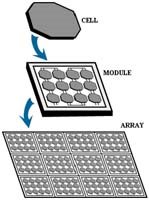 Interesting.. just recently we indians started talking about Solar energy for domestic use but much sunny countries(like Greece) this has been very common. Recently read about Solar usages & ways.
In summer time. Fans are working overtime, the refrigerator is cooling gallons of water and air conditioners are sucking the heat out. Your electricity bill in summer is almost double of what you pay in winter.
Wondered if solar energy can power all your gadgets, lights and cooking devices? Energy can be converted from one form to the other.Of course, a small portion of energy gets lost in the conversion process. Much the same way, the solar energy can be converted to electrical energy in two ways.
Direct method - Electrical energy is produced directly using solar cells or photovoltaic cells. The incident light on the solar cells causes current flow in it. Several such solar cells are cascaded to produce sufficiently large amount of current (at a low voltage) that may be useful for a meaningful application . The output of the solar panel is connected to a battery through a charging circuit . The amount of power that can be stored in the battery or the number of electrical gadgets that can be powered varies depending upon the size of the solar panel. The battery, typically a 12 or 24 volt battery is connected to a sine-wave or pseudo sinewave inverter to produce the 220volt AC required to drive electrical gadgets. There has been no significant development in this technology for reducing the cost of solar cells. So, it calls for a significant initial investment. Electric cars, domestic lighting and electrical gadgets at home can be powered by such a system.
Indirect method - In the indirect method, the heat is collected by large arrays of reflectors that canalise the solar heat onto a long water line.The water gets heated to a temperature that turns water into steam. The steam thus generated, propels a steamturbine (a prime mover to a thermal power generators ).
The rotation of turbines attached to the alternator (alternating current generator) produces electricity.
Using solar power to heat water, cook food and power electrical gadgets is a safe, clean and efficient energy solution . The initial set up cost may be high but in the long run you'll reap the profits.
Govertment should introduce Solar-Friendly-Policies for builders and domestic consumers, for agriculture usage to setup & use Solar system to reduce growing energy problem.
Company in Gujarat got 1000crore deal to export solar cells. Its shame we export but dont use it..
Monday, August 07, 2006
To Save or Not to...!?
got an interesting forward NEO-ECONOMICS: "Saving is Sin, Spending is Virtue"
made me wonder is really Saving is Bad ?? did some googling to validate this & to find different view on this..
Neo-Economics theory underlines.. that what keeps the economy going is consumption expenditure. It is generally held that spending, rather than individual saving, is the essential condition for production and prosperity. Saving is seen to be detrimental to economic activity, as it weakens the potential demand for goods and services.
This allocation of consumer goods and services is what savings is all about.
savings become possible once some individuals have agreed to transfer some of their present goods to individuals that are engaged in the production of tools and machinery. Obviously, they do not transfer these goods for free, but in return for a greater quantity of goods in the future.
Production of goods ready for consumption requires the use of capital goods, that is, of tools and of half-finished material. Capital comes into existence by saving, i.e., temporary abstention from consumption.
Since saving enables the production of capital goods, saving is obviously at the heart of the economic growth that raises people's living standards. Saving and the resulting accumulation of capital goods are at the beginning of every attempt to improve the material condition of man; they are the foundation of human civilization.
now, in today world's - introduction of money will not alter the essence of what saving is all about. Money fulfills the role of a medium of exchange. It enables the produce of one producer to be exchanged for the produce of another produce. a baker exchanges his bread for money and then employs the obtained money to buy other goods and services, implying that he pays for other goods and services with his bread. Money only facilitates payment.
Another important role of money is to serve as a medium of saving. Instead of saving goods, which must be stored, people can save money. In the world of barter, perishable goods are difficult to save for too long. These difficulties are resolved by the money economy.
Through money, people channel real savings, which permit economic activity to take place. Thus, the saving of money by one individual supports the production of another individual, who in turn, by exchanging his produce for money, supports a third individual. Likewise, when a company issues stocks or bonds, the money received for these financial instruments enables the company to buy real savings— goods and services—which will enable it to pursue planned objectives.
When money is saved and then invested it is used to buy or build capital goods. Any of these projects puts as much money into circulation and gives as much employment as the same amount of money spent directly on consumption. Saving in short in the modern world, is only another form of spending.
Without saving and successful endeavours to use the accumulated savings wisely, there cannot be any question of a standard of living worthy of the qualification human.
again taking Japan as example - where the high savings rate that has ranged between 15 percent and 20 percent was blamed for the economic slump. What is happened in Japan is not the result of "too much saving," as suggested by many experts, but rather of too many loose fiscal and monetary policies that continue to destroy households' savings. The misguided policy of lowering interest rates to almost nil is a major catalyst behind the destruction of real savings.
made me wonder is really Saving is Bad ?? did some googling to validate this & to find different view on this..
Neo-Economics theory underlines.. that what keeps the economy going is consumption expenditure. It is generally held that spending, rather than individual saving, is the essential condition for production and prosperity. Saving is seen to be detrimental to economic activity, as it weakens the potential demand for goods and services.
Economic activity is depicted as a circular flow of money. Spending by one individual becomes part of the earnings of another individual, and vice versa. If, however, people have become less confident about the future, it is held that they will cut back on their outlays and hoard more money. So once an individual spends less, this worsens the situation of some other individual, who in turn also cuts his spending.
A vicious cycle is in place: The decline in people’s confidence causes them to spend less and to hoard more money; this lowers economic activity further, thereby causing people to hoard more, etc. The cure for this, it is argued, is for the central bank to pump money. By putting more cash in people’s hands, consumer confidence will increase, people will then spend more, and the circular flow of money will reassert itself.
All this sounds very appealing. Business activity shows that during a recession, businesses emphasize lack of consumer demand as the major factor behind their poor performances. Notwithstanding this,
- can demand by itself generate economic growth?
- what about production of goods and services ?
- Are we to take them for granted?
- Are they always around, and all that is required is demand for them?
it would appear that what impedes economic prosperity is the scarcity of demand. But is it possible for the general demand for goods and services to be scarce?
at given time, the amount of goods and services available are finite but people's demand is infinite. Most people want as many things as they can think of. What thwarts their demand is the availability of means. Hence, there can never be a problem with demand as such, but with the means to accommodate demand.
for example - For instance, when a baker produces bread, he doesn’t produce everything for his own consumption. Most of the bread he produces is exchanged for the goods and services of other producers, implying that through the production of bread, the baker exercises his demand for other goods. His demand is fully covered—that is, funded by the bread that he has produced. Demand cannot stand by itself and be independent; it is limited by prior production. It is the production of bread that permits the baker to procure various goods and services. Bread is a baker’s means of payment. What limits the production growth of goods and services is the introduction of better tools and machinery (i.e., capital goods), which raises worker productivity. Tools and machinery are not readily available; they must be made. In order to make them, people must allocate consumer goods and services that will sustain those individuals engaged in the production of tools and machinery.This allocation of consumer goods and services is what savings is all about.
savings become possible once some individuals have agreed to transfer some of their present goods to individuals that are engaged in the production of tools and machinery. Obviously, they do not transfer these goods for free, but in return for a greater quantity of goods in the future.
Production of goods ready for consumption requires the use of capital goods, that is, of tools and of half-finished material. Capital comes into existence by saving, i.e., temporary abstention from consumption.
Since saving enables the production of capital goods, saving is obviously at the heart of the economic growth that raises people's living standards. Saving and the resulting accumulation of capital goods are at the beginning of every attempt to improve the material condition of man; they are the foundation of human civilization.
now, in today world's - introduction of money will not alter the essence of what saving is all about. Money fulfills the role of a medium of exchange. It enables the produce of one producer to be exchanged for the produce of another produce. a baker exchanges his bread for money and then employs the obtained money to buy other goods and services, implying that he pays for other goods and services with his bread. Money only facilitates payment.
Another important role of money is to serve as a medium of saving. Instead of saving goods, which must be stored, people can save money. In the world of barter, perishable goods are difficult to save for too long. These difficulties are resolved by the money economy.
Through money, people channel real savings, which permit economic activity to take place. Thus, the saving of money by one individual supports the production of another individual, who in turn, by exchanging his produce for money, supports a third individual. Likewise, when a company issues stocks or bonds, the money received for these financial instruments enables the company to buy real savings— goods and services—which will enable it to pursue planned objectives.
When money is saved and then invested it is used to buy or build capital goods. Any of these projects puts as much money into circulation and gives as much employment as the same amount of money spent directly on consumption. Saving in short in the modern world, is only another form of spending.
Without saving and successful endeavours to use the accumulated savings wisely, there cannot be any question of a standard of living worthy of the qualification human.
again taking Japan as example - where the high savings rate that has ranged between 15 percent and 20 percent was blamed for the economic slump. What is happened in Japan is not the result of "too much saving," as suggested by many experts, but rather of too many loose fiscal and monetary policies that continue to destroy households' savings. The misguided policy of lowering interest rates to almost nil is a major catalyst behind the destruction of real savings.
By means of the artificial lowering of interest rates and monetary pumping, the Bank of Japan has been diverting real funding away from wealth-generating activities toward wealth consumers, and in the process has significantly weakened the potential for economic growth. Hence, the only way to prevent the current economic slump from developing into a galloping depression is to abort the present loose fiscal and monetary stance. Furthermore, the size of the government must be cut to the bone in order to enable the private sector to channel savings toward wealth-generating activities.
true is every individual aspires to have a good and comfortable life. What always thwarts these aspirations are the means that have to be produced. Any attempt to create an illusion that people's wishes somehow could be accommodated through the monetary presses is sooner or later shattered by reality—the reality that it is not possible to get something out of nothing.
Subscribe to:
Posts (Atom)